What is generative engine optimization (GEO)? A practical guide
By Anshad P.V, Founder, Axpecto · · 3 min read
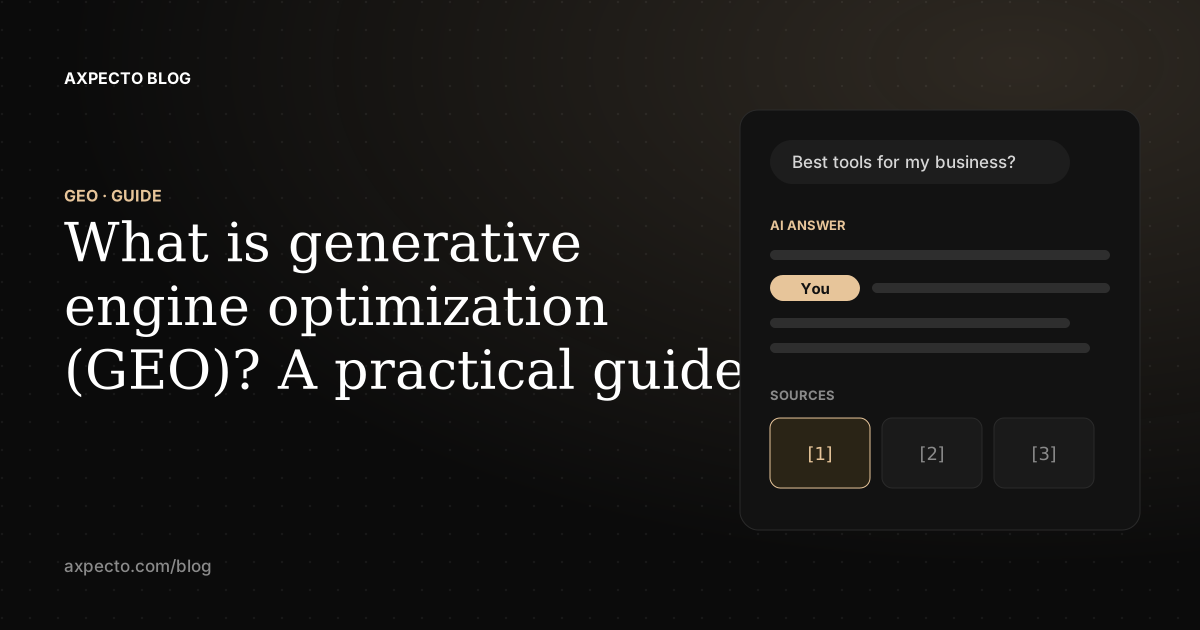
Generative engine optimization (GEO) is the work of making a website easy for AI assistants such as ChatGPT, Gemini, Claude and Perplexity to find, understand, quote and recommend. Where SEO aims for a high position in a list of links, GEO aims to be one of the few brands and sources an assistant names in its single written answer.
It covers four things: whether AI crawlers can read your pages, whether they can tell which business you are, whether your pages hold answers worth quoting, and whether other sites say the same things about you.
How is GEO different from SEO?
| SEO | GEO | |
|---|---|---|
| The goal | Rank high in a list of links | Be named, and linked as a source, in one written answer |
| Who reads your site | Search engine crawlers | AI crawlers, plus assistants fetching pages live while they answer |
| The unit you optimise for | A keyword | A question, asked in plain language |
| How you measure it | Rankings, impressions, clicks | Mention rate, citation rate, share of voice against competitors |
| What one result looks like | Ten links, you choose | One answer that names a few brands |
The two overlap heavily. Assistants with web search ground their answers in search results, so a page that can't be found by search is unlikely to be cited. GEO adds the question of what the assistant does with the pages it finds.
How do AI assistants decide what to recommend?
With web search on, an assistant turns the question into one or more searches, reads a handful of the results, and writes an answer that names some brands and links some of the pages it read. A brand tends to be named when the pages the assistant reads mention it, especially when several independent pages agree. Without search, the assistant answers from what its model learned in training, which can be a year or more out of date.
What does GEO work on?
- Access. AI crawlers must be allowed in robots.txt and not stopped by bot protection, and your main content should be in the HTML the server sends. See robots.txt for AI crawlers.
- Identity. State who you are in Organization structured data, link your official profiles with sameAs, and use one name everywhere. See structured data for AI search.
- Answerable content. Pages that answer real questions in their opening lines, with facts, figures, lists, tables and a visible date. One page per question beats one page for everything.
- Presence elsewhere. Reviews, directories, comparison articles, community threads and press. Assistants trust what several independent sources say over what you say about yourself.
How do you measure GEO?
- Mention rate: the share of answers that name you, on questions that don't name you themselves.
- Citation rate: the share of answers that link a page on your site as a source.
- Share of voice: of all the brands named across the answers, how much is you.
- Position: whether you are named first or after several others.
Measure each AI engine separately, ask the same questions every time so results are comparable, and ask a question again before counting it as lost, because answers vary from one ask to the next. You can do this by hand (here's how) or with an AI visibility audit.
What are the most common GEO mistakes?
- Blocking an AI search crawler while meaning to block only AI training.
- A site that renders its content with JavaScript only, so most AI crawlers see an empty page.
- Counting answers to questions that name your brand. "Is X any good?" names X because the question did.
- Measuring once. A single run is a snapshot of answers that change from one ask to the next.
- Treating it as only a technical job. A perfectly readable site with nothing worth quoting is still not recommended. Sites that win, like Random Talker, have a page for each question buyers ask.